
Pure Emotion: The German Expressionists
"It was part of their desire to connect to their bodies and emotions - to live more emotionally fulfilling lives and express that state of being in their art."

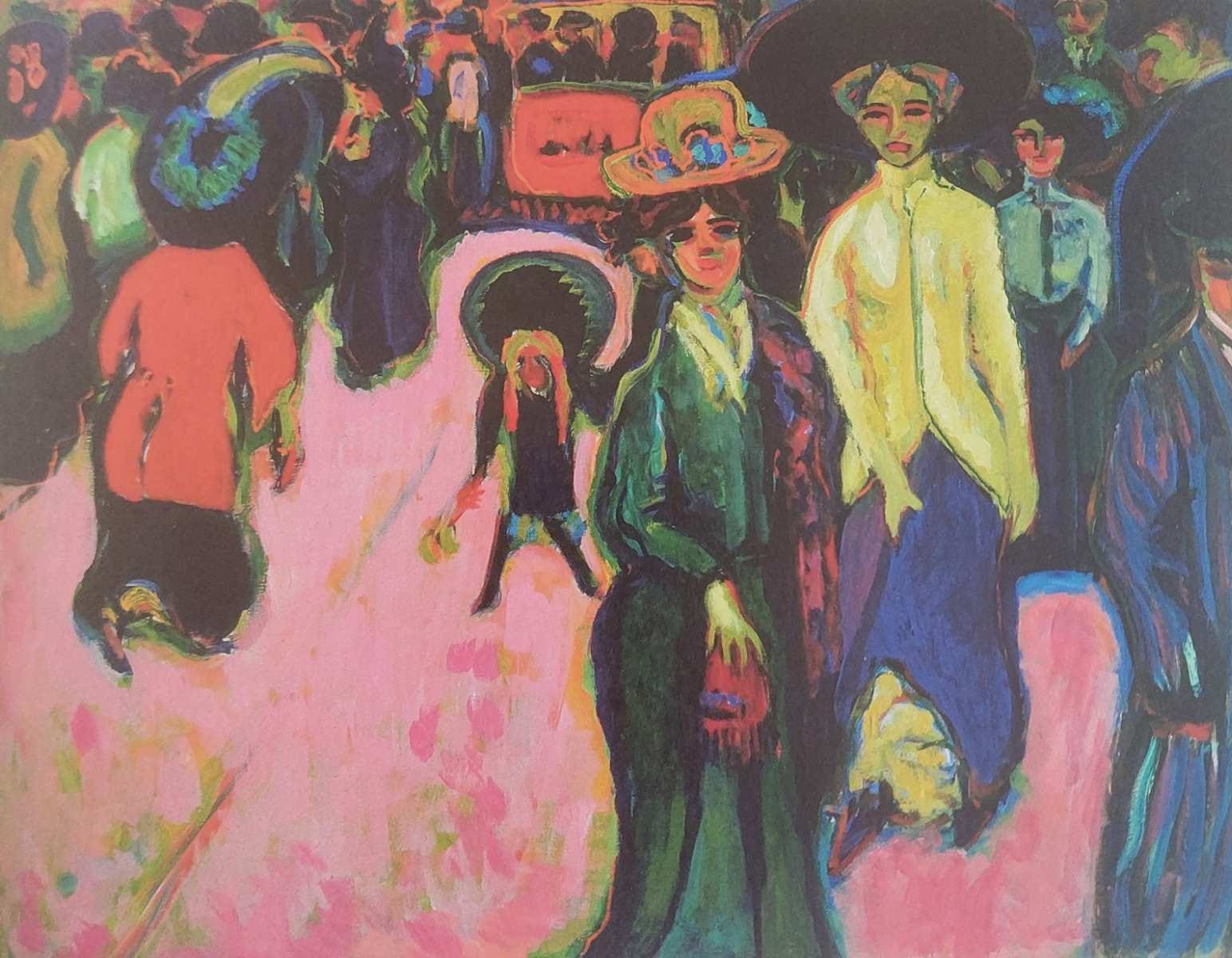
Writing about the German Expressionists is complicated by the fact that they were not a single unified community.
Instead, they were a network of artists - some were friends and worked together; others were rivals, barely knew each other, never met, or worked independently.
There are, though, two distinct groups associated to German Expressionism.
The first was the band of disillusioned young architects, Die Brücke (The Bridge), studying in Dresden who jointly created a collective in 1905.
The founders of Die Brücke included characters like Ernst Ludwig Kirchner, Erich Heckel, Karl Schmidt-Rottluff, and Fritz Bleyl (a more marginal figure who left the group and stopped exhibiting after a couple of years).
They were later joined, for varying amounts of time, by artists like Emil Nolde, Max Pechstein, and Otto Mueller.
More than a collective, the loosely connected second group, Der Blaue Reiter (The Blue Rider), were more like an exhibition society.
The two key players were Wassily Kandinsky and Franz Marc.
They founded Der Blaue Reiter in 1911, and - at various points - other members included August Macke, Alexej von Jawlensky, and Marianne von Werefkin.
Beyond this, although they weren’t closely connected to Die Brücke or Der Blaue Reiter, various individuals - such as Egon Schiele, Oskar Kokoschka, Max Beckmann, and Otto Dix - are often linked to the broader movement.
To make sense of the preoccupations underpinning German Expressionism, it’s important to see it as part of the wider changes playing out within the European art world at that time.
Keep reading with a 7-day free trial
Subscribe to Red Fish to keep reading this post and get 7 days of free access to the full post archives.